November 29, 2025
With the days growing shorter and snow settling on the hills, many in the community look for warmth and a bit of brightness indoors. For more than a century, live theatre has offered just that in Vernon, with fall and winter traditionally marking the return of local theatrical seasons.
Before the Empress Theatre opened its doors in 1912, performances often took place wherever space was available. Berry’s Drugs (on the site of today’s Nolan’s Drugs) once hosted a concert by the Royal Welsh Choir in 1910, an early indicator of Vernon’s enthusiasm for the performing arts.
One of the first major productions at the new Empress Theatre was The Geisha, staged by the Vernon Musical and Dramatic Society. Both performances sold out, with even the standing room filled, a testament to the community’s appetite for theatre. This moment in early cultural history is also captured on the 32nd Street mural.


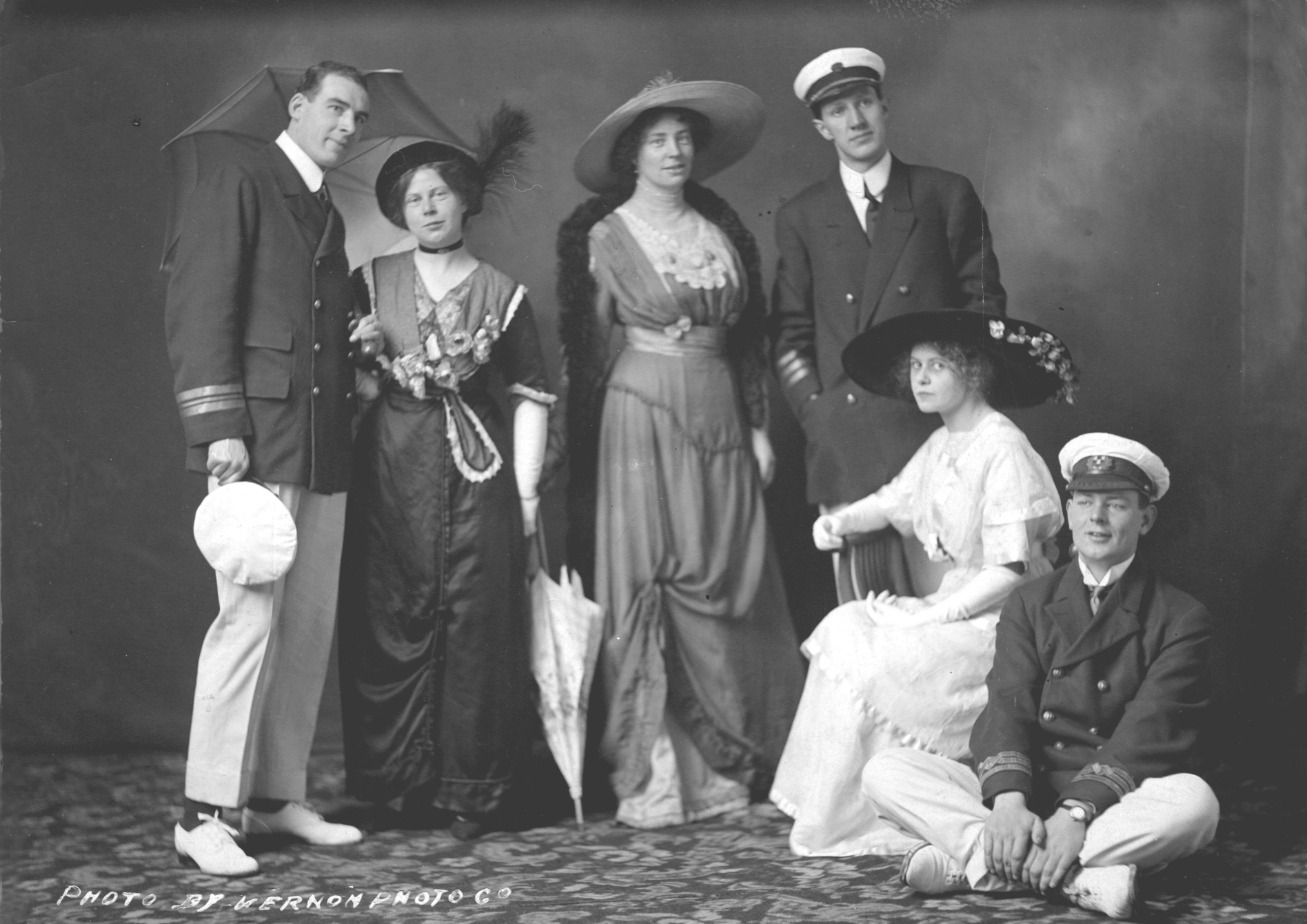
The 1920s and ’30s marked a period of significant growth. The Elk Players, associated with Vernon Lodge No. 45, presented A Little Bit of Fluff in 1923. Though the Vernon News acknowledged that “amateur productions at best, are a very uncertain quantity,” the “continuous roars of laughter and applause” demonstrated how well the production was received. The troupe even toured the show to Kamloops, Oyama, and Kelowna.
Comedy appeared to dominated this era. In 1928, the Kalamalka Players staged Noël Coward’s Hay Fever, a light three-act comedy featuring the eccentric Bliss family. That same year, the All Saints’ Anglican Church men’s club produced the light opera Trial by Jury, first popularized in London in the 1870s. In 1932, the Rotary Club added to the momentum with Foxy Quiller, a comic opera set in 1825 Portsmouth.

The 1940s carried a distinct wartime influence, with productions taking on more musical and military themes. These included Hullo Vernon (1943), presented by the Canadian School of Infantry, and Rookies Play Hookey, staged by the Vernon Army Camp in support of the Milk for Britain Fund and the Soldiers’ Entrainment Fund. The postwar years set the stage for further growth, with the 1950s seeing a stronger focus on choral and orchestral productions.

These examples represent only the first few decades of theatre in Vernon—a brief introduction to a much longer and continually evolving history. Subsequent years introduced new groups, changing tastes, and shifting performance spaces, reflecting how local theatre continued to adapt over time.
Archives Manager, Gwyneth Evans