
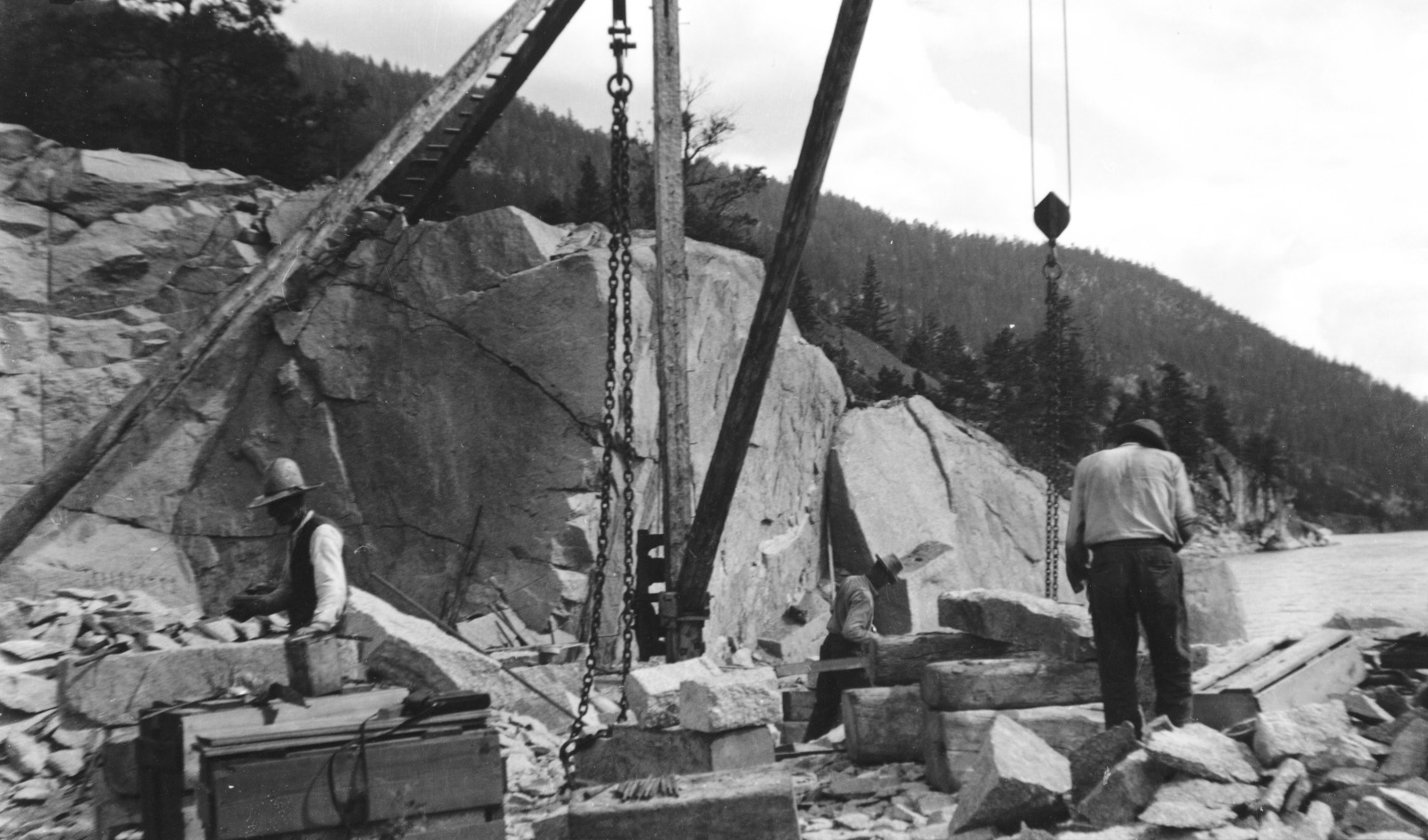
One of Vernon’s most distinctive landmarks, the Vernon Courthouse, is made all the more impressive by the fact that its granite was quarried locally. The building is one of several in the city constructed with stone from the Vernon Granite and Marble Works, which operated quarries on the east side of Okanagan Lake, about 10 kilometres south of Okanagan Landing.
The local quarrying enterprise was long associated with the Russell and Inkster families. James Russell and William Inkster were both trained stonecutters, apprenticed in Glasgow and Aberdeen respectively, who came to North America around the turn of the 20th century. Like many tradesmen of their time, they moved from one construction site to another where their specialized skills were in demand.
Russell arrived in Vernon in 1902 with his wife and four children, after working on the construction of the B.C. Legislature in Victoria. Some accounts suggest he came to the area to work on the planned courthouse. Inkster followed a year later, in 1903. Around 1909 or 1910, Russell left Vernon for a stone-cutting job in California and did not return. Inkster, who had remained in the area, later married Mrs. Russell.
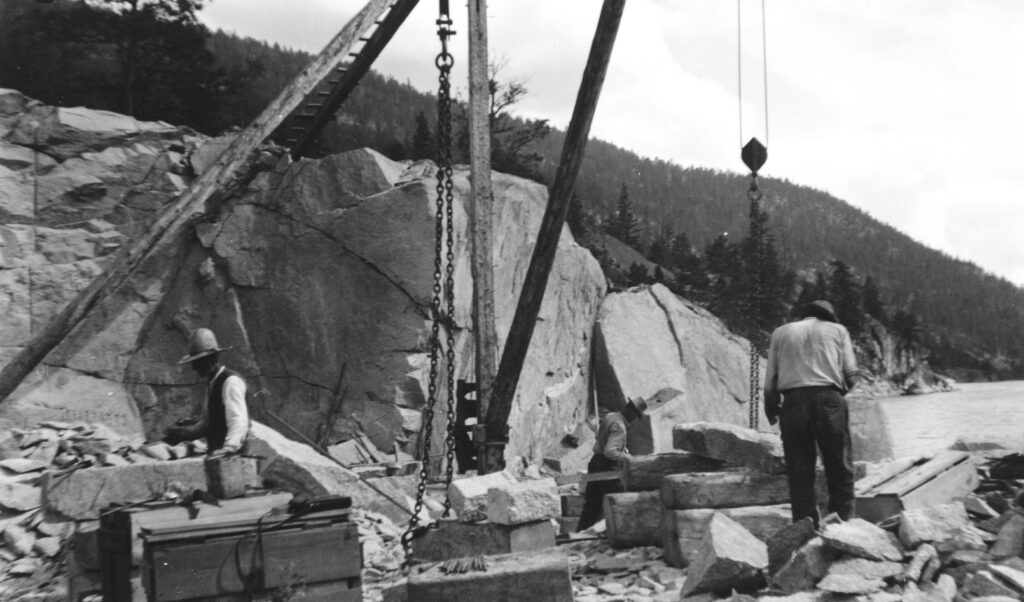
Construction on the Vernon Courthouse started in 1910, with between 65 and 75 men on the job. The granite came from a quarry run by the Vernon Granite and Marble Works, owned by Price Ellison and managed by William Inkster. The quarry, about 75 feet long along the lakeshore, produced granite with a subtle pink tone.

Approximately 30,000 cubic feet of stone were used in the courthouse. Each piece was cut and numbered according to blueprints, then transported by barge to Okanagan Landing, by rail to Vernon, and finally hauled uphill by horse to 27th Street. The large lintel stone above the main entrance proved too heavy to move in one piece and had to be cut in two at the bottom of the hill.
The courthouse was completed in 1914. Afterward, Inkster purchased the quarry operation from Ellison, and later his stepson, Arnold Russell, took over. The Vernon Granite and Marble Works also worked the nearby Benjamin Lefroy Quarry, supplying stone for the former Vernon Post Office and other local buildings. The Inkster Quarry proved more productive over time and remained active into the 1940s, providing granite for the Vernon Cenotaph and many headstones in Pleasant Valley Cemetery.

As building practices shifted toward brick and wood construction, demand for granite eventually declined. Still, the Vernon Courthouse remains a lasting reminder of the city’s early craftsmanship and the local industry that helped shape its landscape.
Archives Manager, Gwyneth Evans