

A once-popular lodge in Coldstream has been lost to time for more than 65 years.
In 1906, Ronald McLimont and his sisters Amy and Alice, members of a prosperous Quebec family of wholesale dry goods merchants, acquired a five-acre lot on the shores of Kalamalka Lake. Not long after, they commissioned the construction of an impressive residence. Designed by Scottish-born Canadian architect Robert Findlay and built by North Okanagan contractor T. E. Crowell, the house was celebrated as a grand example of Shingle and Tudor Revival architecture, distinguished by a sweeping verandah supported by Classical columns.
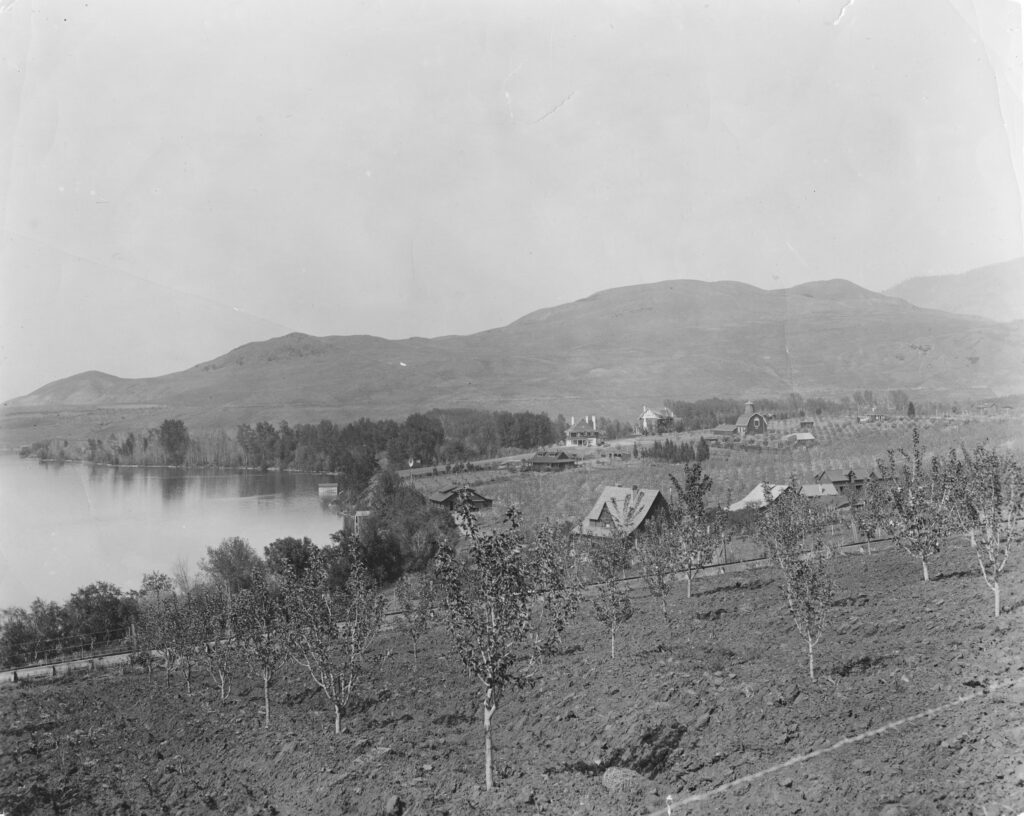
A third McLimont sister, Mary Jane, married Rupert Charles Buchanan, and together they settled on the neighboring lot. That same year, Ronald McLimont expanded his property by purchasing additional land and planting 25 acres of apple trees. As was customary for prominent residences in the Long Lake Subdivision—an area once owned by Price Ellison, later part of the Coldstream Ranch, and eventually subdivided by the Coldstream Estate Company—McLimont’s home was given a distinctive name. It became known as Orchardleigh, while the Buchanan home next door was titled Lake House (now known as the Mackie Lake House). During McLimont’s ownership, Orchardleigh gained a reputation for its gardens, which were profiled in botanical publications in both Canada and England.

In 1925, McLimont sold his property to M. A. Curwen and returned to Quebec. Twenty years later, in 1945, it was purchased by M. V. McGuire, who converted it into a guest house. The house enjoyed a new life as Orchardleigh Lodge, offering hospitality to visitors and locals alike, until tragedy struck in the summer of 1960.

On the morning of June 26, five families visiting for end-of-term celebrations at the Vernon Preparatory School were enjoying breakfast on the porch. Among them was six-year-old Tony Lort, who ran across the lawn with a water pistol, shouting “fire.” At first his warnings were mistaken for play, but when smoke began drifting from a third-floor room, the danger became clear. Crowds quickly gathered to watch, yet the flames spread too fiercely for firefighters to contain. By midday, only the chimneys were left standing. Fortunately, no one was injured, and much of the ground-floor furniture and equipment had been carried to safety.

The destruction of Orchardleigh Lodge was one of several notable fires that struck Coldstream structures between 1944 and 1960. These losses spurred the District of Coldstream to pass Fire-Protection Bylaw 385, which established a volunteer fire brigade and led to the construction of a municipal fire hall on Kalamalka Road.
Although the lodge itself is long gone, Orchardleigh remains part of Coldstream’s story, remembered as both a grand early residence and a landmark whose fiery end reshaped the community’s approach to fire protection.
Archives Manager, Gwyneth Evans