
December 19, 2025
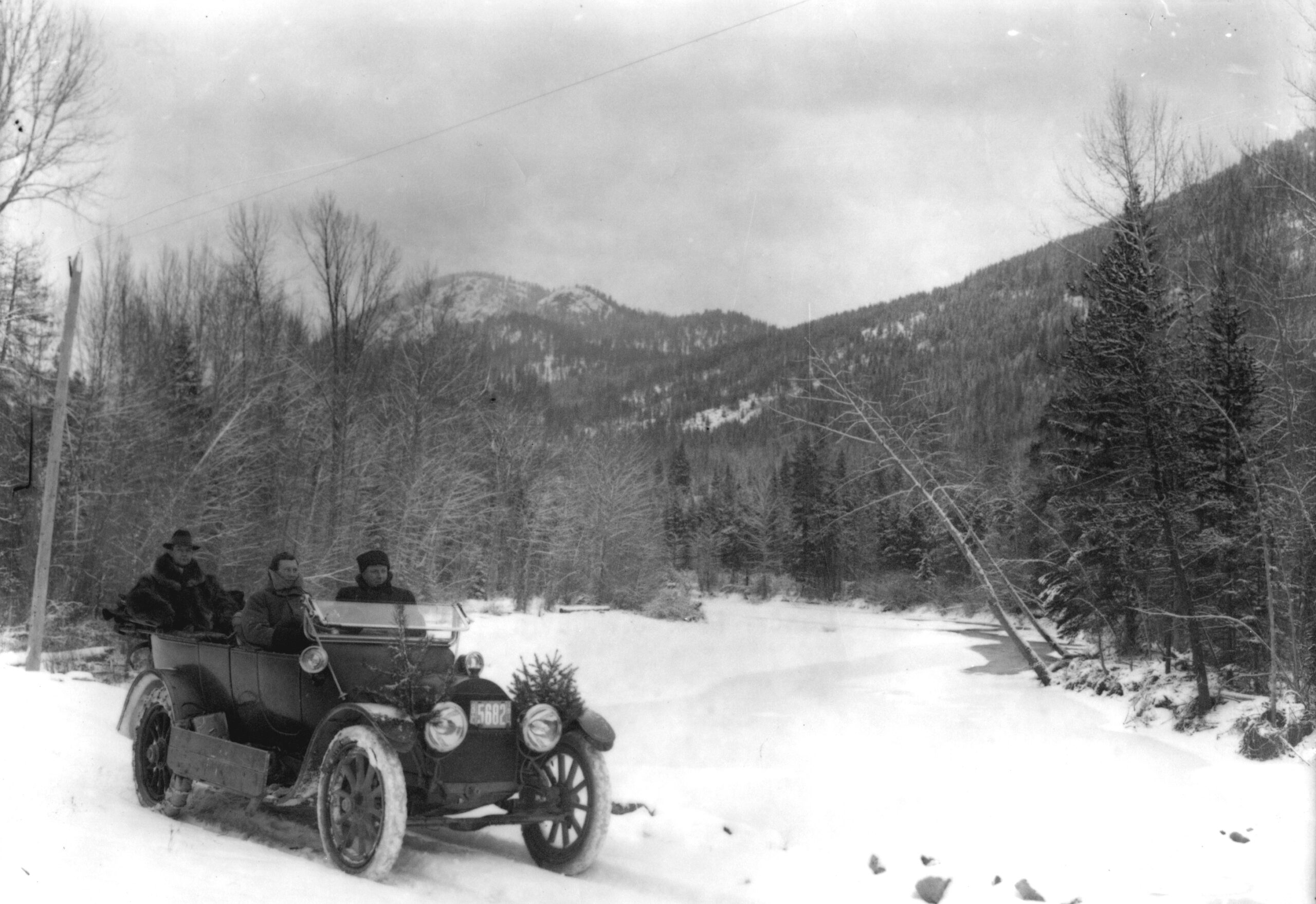
In the early 1930s, a new seasonal industry began to take shape in the North Okanagan and Shuswap regions: Christmas tree harvesting. In November 1933, the American J. Hofert Company secured a contract to ship Christmas trees from Canada to the United States. An agent from the company traveled to Salmon Arm to survey surrounding districts and arrange the purchase of suitable trees. Once selected, the trees were bound together in bales and stacked on open CNR rail cars to what the Vernon News described as “an imposing height.” The first shipment, consisting of 1,236 bales, was sent to Indiana, followed shortly by a second shipment of 1,354 bales destined for Ohio, traveling across the Prairies before crossing the U.S. border.
Local newspapers were quick to predict that Christmas tree cutting could become a major regional industry. Over the next few years, this prediction largely came true. By the mid-1930s, residents began referring to Hofert Company agents as the “Christmas Tree men.” In one notable year, the Vernon district shipped 25 carloads of trees—around 125,000 in total. Cutting, sorting, and bundling these trees employed roughly 100 men, providing much-needed work during the slower winter months. The seasonal opportunity benefited not just loggers and railway workers, but also ranchers and farmers. The provincial government also profited, earning one cent per tree in revenue. For many in Vernon, this arrangement was a welcome boost to the local economy.
By 1939, however, concerns had emerged over the long-term impact of large-scale tree harvesting on local forests. To address these worries, the Department of Lands published an article titled “Christmas Trees and Forest Conservation.” It explained that the majority of the trees used in the trade came from privately owned lands being cleared for agricultural purposes, while acknowledging that certain practices could be wasteful or damaging. The article reassured readers that conservation measures were in place to protect the broader health of the forests.
The J. Hofert Company itself had a long history, having been established in 1880. By the 1930s, it had grown into the largest Christmas tree cutter in the United States, shipping over six million trees annually. Tags affixed to Hofert trees assured buyers that harvesting was carefully managed under government supervision, with the goal of improving the growth and health of surrounding trees. The company was also among the first manufacturers of Christmas light strings and continues to operate today.
Despite the initial excitement in Vernon, the Christmas tree industry, like many others at the time, was hit hard by World War Two. Labour shortages and wartime restrictions on outdoor Christmas tree lighting—implemented to reduce potential air raid hazards—limited production, and the industry never developed into a major source of income for the region. Today, however, it survives on a smaller scale, maintained by family-run farms that continue to grow and sell Christmas trees.
Archives Manager, Gwyneth Evans